|
Facial therapy specialist Veronica Massa considers what happens in our bodies when we smile and what we can gain from smiling. Say cheese :-) How many times a day do you smile?  Allow me to invite you to do a little experiment. Please bring your attention to your facial expression, are you frowning, are you pulling a face, is your expression neutral, are you smiling? And how are you feeling, what is your mental/emotional state right in this moment? Please take few seconds to acknowledge that. Now please flash your most beautiful smile. On the left is one of mine to inspire you!:) How does that feel? Is there any change? Are you perhaps feeling your mood has lifted up? Are you experiencing a happier feeling? More positive? What you are experiencing is the power of smiling! Let me explain. You have probably read the title "the face-mind-heart connection" on the homepage of my website https://www.urbangoddessrituals.com/ and you probably know of my fascination with this subject. In other words, how our facial expressions affect our mind, how our thoughts affect our facial expressions, how our mind, heart and face are interconnected on a profound emotional level. How our facial muscles movements are connected to our facial expressions and therefore emotions. The muscles in our face attach to other muscles or directly to our skin rather than to our bones like the muscles in other areas of our body. Because of this, they are heavily influenced by our emotions. It is primarily our emotions that initiate and activate facial muscles movement which we call facial expressions. The awareness of this connection has been a focus of my work for over a decade and I Iove witnessing client's faces change as they become more aware of their emotions, thoughts and state of mind and their heart opens and expand. Did you know that your facial expressions, by moving your facial muscles send messages to your brain changing brain functioning? So, WHAT HAPPENS TO YOUR BRAIN WHEN YOU SMILE? We activate 53 muscles with a single smile! It is such a great facial exercise.The main two muscles used for smiling are the major zygomatic muscle on your cheeks, pulling up the corner of your mouth and the orbicularis oculi muscle around your eyes. A smile is not just a facial expression, it is said a smile increases your face value! A smile is an approach to deal with adversity and negativity on a daily basis, a smile can just change the attitude we have towards others, towards life and how we deal with problems. With a smile we connect with others on a heart level based on trust. Smiling have a positive effect on our physical and mental health by decreasing stress-enhancing hormones (including cortisol, and adrenaline) and increasing mood-enhancing hormones, the endorphins that relieve pain and stress. Smiling also reduces heart rate and decreases blood pressure. When we smile we release four main neurotransmitters (brain chemicals), Dopamine, Seratonin, Endorphines and Oxitocine which help releasing stress and and make us feel calm. DOPAMINE acts on our ability to think and plan. It also produces a feeling of pleasure. A study reported that a single smile generates the same amount of dopamine as 2000 bars of chocolate! OXITOCINE also called the love hormone, helps us develop strong bonds. SERATONIN makes us feel good and happy, promoting relaxation and a feeling of wellbeing. It is a naturally produced antidepressant, helping counteract anxiety and stabilizing our mood. ENDORPHINS reduce pain and stress levels, reduced heart rate and blood pressure. Make us happier and impruve the immune system. Some recent study has shown that the facial muscle stimulation that happens with covert smiling stimulates the amygdala which is the part of our brain that has to do with emotional events, responsible for regulating emotions, motivation, and the sense of reward. The stimulation of the amygdala therefore is responsible for creating positive state of mind and helping overcoming a depressive state. Smiling is a powerful tool for happiness or mental wellbeing, good health and (research has found) to live longer! Coming to a conclusion, here is my suggestion: practice smiling and hold your smile for 15 seconds. Smile consciously every single morning upon rising (add the feeling of gratitude), feel the effect of the “happy hormones” and witness the healing power of a smile. Happy smiling! 
0 Comments
Acupuncturist Miha Rosta explores what it means to be 'healthy' - if this is how we are meant to generally be, what being ill or injured means and how we interact with life.  Are we supposed to be healthy? I suppose you expect an Acupuncturist to say: Yes, of course. It is the most important thing in life. And you are kind of correct on that. Even our grandparents used to say: “health above all”. But are we really supposed to be healthy people? I don’t think so, not in that sense. And here is why.. Before that, I need to make a confession. Recently, during one of my treatments, a client said to me: “I just want to feel better”. My response? I laughed. Yes, I laughed. How unprofessional a response that was (I thought instantly), but why did I laugh? For me, it was simply an incredible comedic response to reality. Of course, they want to feel better; that is what all of us wish for. It is so obvious that it triggered a guttural laugh in me. My laugh was short, with a slight bitter after taste. Bitter, because the fact is that we see our health as a function, as a necessity, and often as a nuisance to our everyday life. Whether we build our identity around being the healthy person, or the person who has no time for themselves, in both cases we treat it separately from ourselves. Not to romanticise illness, but the most overlooked function of disease is to bring us back to the present moment. It is so we are forced to reconsider our priorities and the way we live our lives. It is often a warning, a wake-up call. Which, when ignored, turns into bigger and bigger red flags, leading to the hospital. Just to be clear, I am not saying all injuries, accidents, and developmental disorders are a “message” or a lesson. But however we look at the way they form our experience will determine the quality of life we develop over the years. What I am trying to touch upon is that participation in whatever life presents to us is the best response. When we are sick, we are sick. Through sickness and hardship, we grow, reflect and thrive. We don’t need to idolise hardship, but looking away and ignoring the reality will only halt our healing journey. On what it means to be healthy. It is not about how many workouts we do in a week, or how well we eat. It is about how we participate in life in any and all given moments. Eating well and meditating daily can bring us closer to a fulfilled (healthy) life, or it can drag us further away from it if it becomes a passive, stale aspect of our personality. We can’t be healthy. The only thing constant (physically speaking) is death. What we can do is to participate in our ever-changing health. That is homeostasis. Maintaining an internal (mind) and external (body) environment in which we can survive and thrive. Constantly. Am I an Acupuncturist because I have got a degree and insurance? Or is it because I am actively applying this healing art, supporting a multitude of people weekly? Or because I can make everyone’s pain disappear (which I cannot), as unfortunately am not (yet :D )perfect. I do not think it would be accurate to call myself an Acupuncturist if I was not participating in the life of others in that capacity. I hope you find this article somewhat helpful. I just wanted to share some of my current musings. :) And I promise I will try not to laugh next time.. 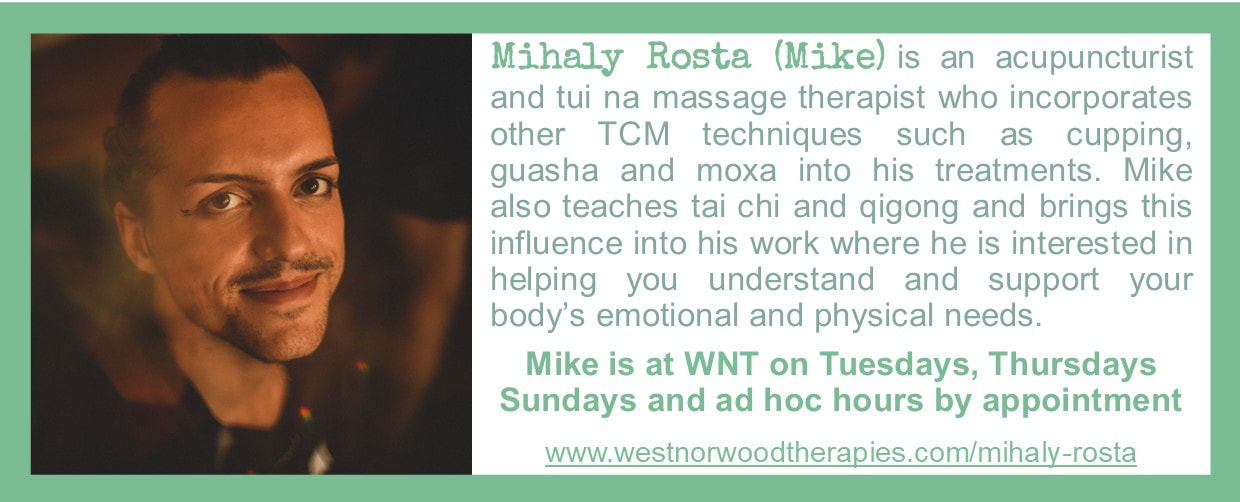 Acupuncturist and tai chi teacher Miha Rosta explores how our bodies adapt to our habits, how this can affect our posture and can cause longer term issues, and what we - and he - can do to help. Love is a really potent emotion; it makes us feel discombobulated. Hence the term, Head over Heels.. However, I am not really here to talk about the wonders of human connection, but rather about the magical adaptability of the human body. When we fall in love, we sort of lose ourselves. We find ourselves distracted, yet fixated on one thing. The very same happens to us when we have not been taught to carry ourselves correctly (healthily) in the world. In love, we lose our footing to the overwhelm of positive emotion. In everyday life, we lose our core to the overwhelm of comfort (lounging) and discomfort (maladaptive muscle tension). The result is the same: head over heels. But the reason is fairly different. It would be rather impossible (and extremely smug) to say that it all starts in the same place; however, the deep core muscles are the number one culprits for forward head posture. Which, sadly, over time, results in a hump in the upper back. We might be thinking, “Why is my body doing this to me?” And the answer is: because it is trying to stabilise you. The body is a wonderfully adaptive machine. It does its absolute best to stay alive and as functional as possible. Disease is simply a manifestation of the body’s response and effort to stay alive. Now, the good news is that most of us have a choice to avoid looking like Quasimodo. Luckily for both of us, I have been fascinated by posture and integrated movement for a few years now. I have developed (and am still improving upon) a way to restore correct posture thanks to my many and truly amazing teachers who have been obsessed with healthy movement for decades. To correct your head-over-heels problems, we need to primarily address:
Now that is a very simple list; however, each step has a multitude of foundational steps and conditions which need to be corrected, tested and trained into your everyday life in order to facilitate a change in your posture. Before I say more on that, here is a little blurb on the core. There are different explanations around why it is so important, but one thing that all movement specialists agree on is that movement comes from the centre. And when the structures around the centre (core, hips, diaphragm, rib cage, pelvic floor, etc.) are misaligned, it results in a cascade of issues everywhere in our musculoskeletal system. When we lose stability in our centre, our body (and mind) adapts in myriad ways in order to restore it; hence, the head creeps forward in order to keep us balanced. A few examples of the work that integrative postural correction requires:
Forward head posture is just an example of a maladapted posture. And it may or may not come with pain. However they will greatly contribute to degenerative disorders later down the line. All postural misalignments can be adjusted, such as scoliosis, but the outcomes are greatly dependent on how well you can work with your therapist. If you or anyone around you suffers from poor posture, chronic back pain, shoulder pain, or hip pain. Or other nerve-related problems or hypermobility, then please reach out. I would be more than happy to help. Sports, remedial and pregnancy massage therapist, Becky Stockley, shares what you can expect from a pregnancy massage from her, from the benefits to the style of treatment and modifications to a general massage session Pregnancy is a special experience that is individually unique. For some it can be plain sailing whilst for others it be an uncomfortable and complicated time. Massage can be a way for a mother to reconnect with her body, calm her nervous system, soothe aches, and ease the effects of postural changes. Is it safe?
What are the benefits of massage during pregnancy?
What does a pregnancy massage look like?
 |
AuthorBlogs from the WNT team. For our blogs from before June 2020 please see individual profile pages - it's a good way to get to know practitioners too. Archives
September 2026
Categories
All
|
 RSS Feed
|
Visit us - by appointment only please - in the office block in the Access Self Storage premises at 443 Norwood Road, London, SE27 9DQ
[email protected] Phone - please contact practitioners directly, or if not in a rush you can leave a message for us to call you back at 07931876931. |
|